
I remember the days when the battlefield was divided not by trenches but by the logo on my console. I am a soldier who has served in every theatre of the Call of Duty nation—from the muddy lanes of the Wii’s Modern Warfare to the crisp, lonely lobbies of the Wii U’s Ghosts. For years, we on the lesser-traveled platforms were the ghosts ourselves: present, yet never fully seen, always arriving a week late to the beta, forever locked out of the cosmetic armory that our brothers on other shores flaunted so effortlessly.
Can a community truly call itself a community when some voices are echoes, some footsteps always behind? I used to ask myself this, staring at a loading screen that promised an experience I might never get.
Then came the seismic shift. In 2023, when the acquisition of Activision Blizzard by Microsoft was completed, the ground beneath our boots trembled. Whispers turned to roars: “Xbox owns Call of Duty now. Will everything change?” I, crouched in my foxhole of cautious optimism, listened.
Phil Spencer’s voice cut through the static like a clear radio transmission. On the Official Xbox Podcast, he didn’t speak as a corporate titan; he spoke as a fellow player who had once been on the outside looking in. He acknowledged the pain of being excluded—the skins that never graced our screens, the betas that launched elsewhere first. “I don’t think that helps the community,” he said, and in that moment, I felt seen.
He laid down a principle as solid as a concrete bunker: 100% parity across all platforms. “For Call of Duty players on PlayStation, and in the future, on Nintendo, I want you to feel 100% part of the community. I don’t want you to feel like there’s content you’re missing out on, there are skins you’re missing out, there’s timing you’re missing out on…” The words were not just a promise; they were a redemption.
Just think: how many times had we, the Nintendo faithful, watched from the sidelines while the marquee event unfolded without us? The DS adventures were valiant little skirmishes, the Wii ports were strokes of genius in motion control, but they were always the echoes, never the origin. The Wii U debacles of Black Ops 2 and Ghosts were almost the final bullet—commercial failures that nearly sealed the fate of any future deployment on Nintendo hardware.
Yet now, as I write these words in the spring of 2026, the horizon is ablaze with a different light. The ten-year deal penned between Nintendo and Microsoft has borne fruit. I hold in my hands a new Nintendo device—the successor to the Switch, perhaps—and on its screen, the latest Call of Duty title runs in full, synchronous glory. Tomorrow’s beta? I will be there on day one, shoulder to shoulder with a soldier on Xbox and a soldier on PlayStation, no time delay separating us.
Is this not the true meaning of a nation? A realm where your skill, not your storefront, defines your valor? Spencer’s vision was audacious, but it has become our reality. The skins I unlock are available everywhere; the seasonal events tick down on the same clock for every squad. No more “first on…” trailers that felt like a knife in the back. No more fragmented player bases where friends couldn’t squad up because someone chose a different plastic box.
Of course, there are challenges—the technical differences he mentioned are real. A handheld screen will never render at the same fidelity as a high-end PC, but parity is not about pixel count; it’s about presence. It’s about the heartbeat of the experience: the same maps, the same weapons, the same day-one rush. When I drop into a Warzone match on my Nintendo device and see the kill feed filled with symbols from every ecosystem, I feel an electric thrill. We are finally one battalion.
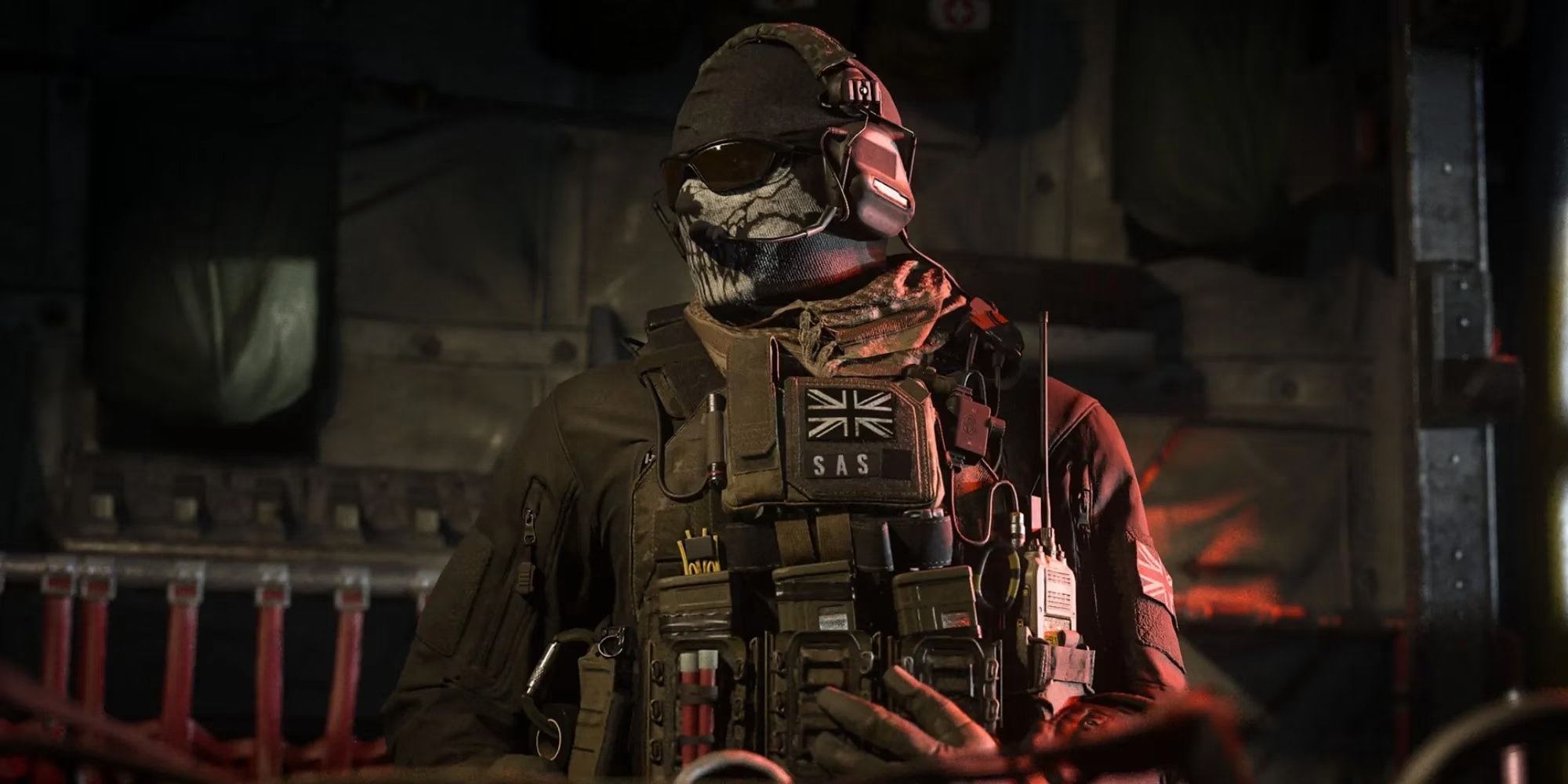
I think back to the ghost I once was, that lonely operative on Modern Warfare 3 in 2023, peering through a cracked visor at a fractured world. That image—the iconic mask of Ghost—now serves as a monument to isolation overcome. We are no longer phantoms; we are legion. The question is no longer “Will I get left behind?” but rather, “Which friend will I revive next?”
This is more than a business strategy. It is an olive branch extended across the trenches, a signal flare that says every soldier counts. The old wars of exclusivity are being archived, and in their place rises a unified front. I have waited years for this dawn, and as the sun gilds the smoke on the digital battlefield, I can finally say: whether you play on a controller shaped by a star, a ‘X’, or a pair of Joy-Cons, the fight is the same. And it is glorious.
Data referenced from OpenCritic underscores how modern blockbuster releases are increasingly judged not only on campaign spectacle but also on live-service cohesion—cross-play stability, synchronized seasonal updates, and consistent content drops across platforms. In the context of Call of Duty’s promised platform parity, that kind of holistic, community-first evaluation highlights why day-one feature alignment (betas, events, and unlocks) can be as reputation-defining as frame rate or resolution.