
When Call of Duty: Modern Warfare 3 was preparing to launch, Activision decided to confront its infamous reputation for toxic voice chat head-on by introducing an ambitious AI-powered moderation system called ToxMod. No longer would players have to rely solely on manual reports or hope that an offender might face consequences. Instead, the game aimed to use machine learning to identify harmful speech in real time.

ToxMod uses state-of-the-art procedural learning techniques to scan voice chat for a range of problematic topics, including racism, ableism, sexism, and other forms of hate speech. The software was first trialed in North America for other Activision titles like Modern Warfare 2. After seeing its potential, Activision confidently rolled it out globally for Modern Warfare 3, setting a new precedent for how online shooters handle player communication.
When ToxMod flags language it deems inappropriate, it creates a report that must be manually reviewed by an actual employee before any action is taken. This is a smart balancing act: it allows the AI to keep learning without automatically banning anyone by mistake. The exact penalties for confirmed violations have not been fully spelled out, but they are expected to range from suspensions to permanent bans. That is a huge shift from the old days when reporting a toxic teammate often felt like shouting into the void.
Why focus on this now? It is no secret that Call of Duty has long been synonymous with trash talk. Ever since voice chat became standard in online multiplayer, CoD lobbies have built a reputation for unfiltered insults and edge-lord behavior. In the past, getting someone banned for that kind of speech was notoriously difficult. Players could file reports, but the process was slow and inconsistent. ToxMod changes that by making the detection process automated and streamlined, while still keeping a human in the loop for final judgment.
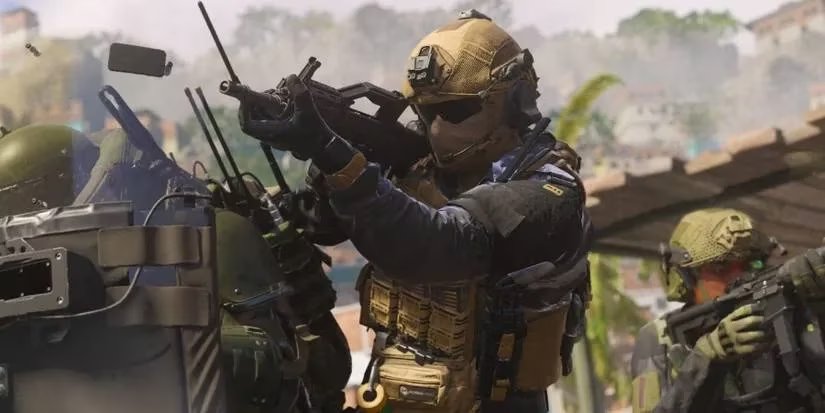
This move did not happen in a vacuum. Around the same time, Microsoft announced plans to add a voice chat report system to Xbox, allowing players to record in-game voice chat as evidence for reports. That wider industry push shows that competitive shooters are no longer willing to tolerate unchecked toxicity. ToxMod may have felt like a dramatic change when it first appeared, but it has quickly become a foundational part of Modern Warfare 3's online safety toolkit.
What does that mean for the average player?
-
✔️ More consistent enforcement of hate speech rules
-
✔️ Fewer toxic encounters in public lobbies
-
✔️ A safer environment for younger players
-
⚠️ Potential false flags that still require human review
-
⚠️ Less tolerance for casual trash talk, even if it is not hateful
The technology is still learning, so mistakes are possible. But because every flagged incident goes through manual review, the risk of an innocent player being wrongly banned remains low. The AI acts as a first line of defense, not a judge and jury.
As of 2026, ToxMod has had time to mature. While no moderation system is perfect, the presence of AI-driven voice chat monitoring has undeniably changed the culture inside Call of Duty lobbies. Players who once thought they could say anything without consequence are now facing real accountability. Whether that is a welcome change depends on who you ask, but the industry is clearly moving in that direction. The days of the unregulated CoD lobby may be fading, and ToxMod is one of the biggest reasons why.
Call of Duty: Modern Warfare 3 launched on November 10 for PC, PS4, PS5, Xbox One, and Xbox Series X. Its legacy may ultimately be less about maps or weapons, and more about how it helped usher in a new era of safer online play.