
As the late autumn sky of 2026 draped itself in muted greys over the Midwest, Jake sat in front of a monitor that still hummed with the subtle static of a decade-old passion. The glow of Call of Duty: Modern Warfare 3 on screen was a familiar sight, its icon now weathered by three years of patches, seasons, and fleeting metas. Yet, every time he scrolled past the armory, his eyes lingered on a cluster of fully-leveled guns that had become like old friends: the M4, the Vaznev-9K, the SP-R 208, the FJX Imperium, and the boisterous KV Broadside. They were not merely virtual firearms; they were relics of a strategic frenzy that had consumed him in the waning weeks of 2023, when the gaming world first learned that Modern Warfare 2’s arsenal would sail forward into the uncharted waters of Modern Warfare 3.
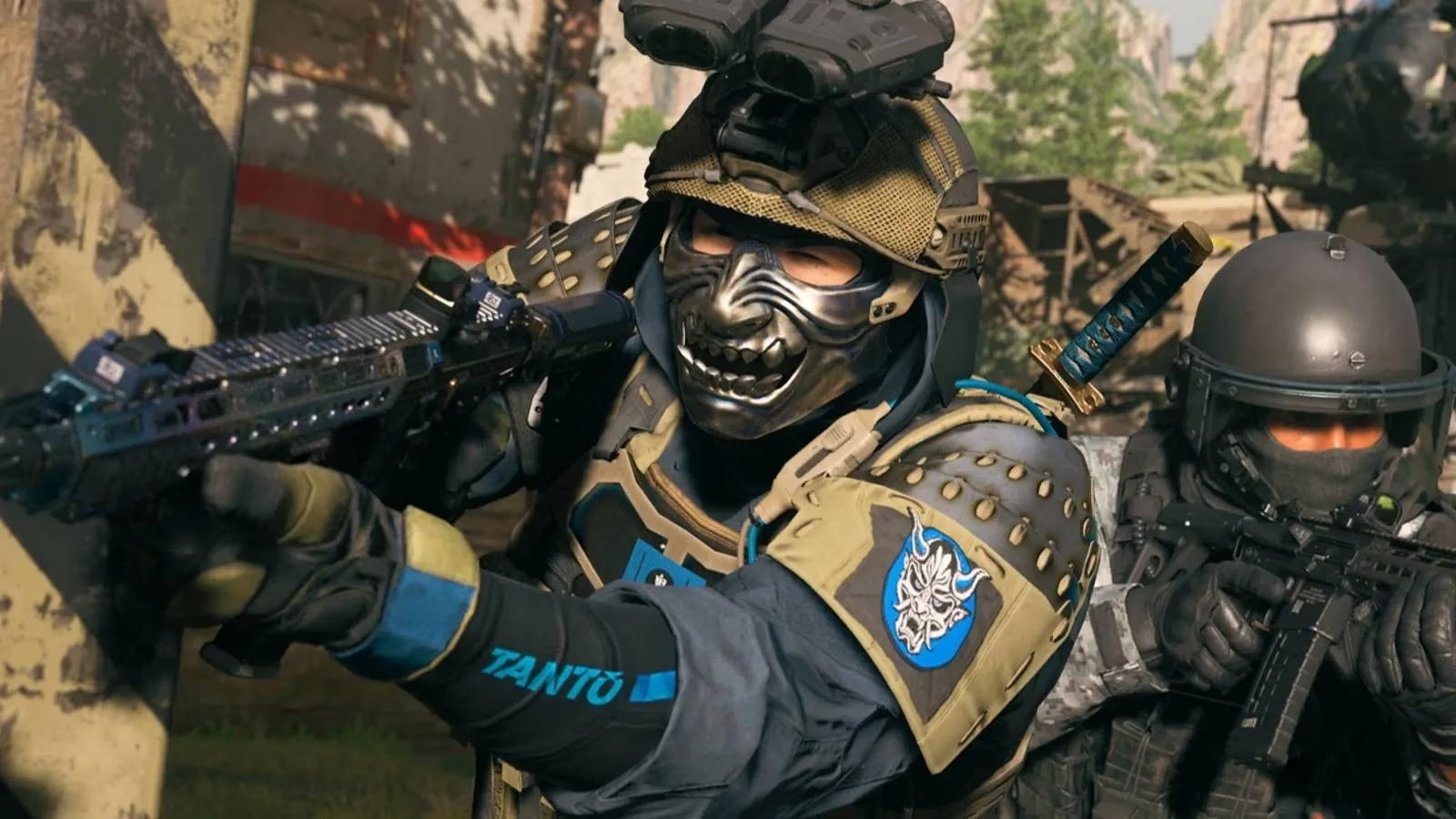
It had started as a rumor, the kind that spreads through Discord servers and subreddit threads like the scent of rain before a summer storm. Then, confirmation: every attachment, every camo, every painstakingly unlocked level of Modern Warfare 2’s guns would not be left behind. For Jake, a player who treated his loadouts with the meticulous care of a clockmaker, the news hit like a lightning strike on a dry prairie. He immediately recognized the opportunity. Others planned to grind the fresh weapons of MW3 on day one; he would become a time traveler, bringing a precision-honed arsenal to a battlefield still struggling with stock iron sights.
The first weapon he elevated into a masterpiece was the M4 assault rifle. In his hands, the M4 was not just a dependable workhorse; it was an octopus in a coral reef, its modular limbs adapting seamlessly to any role the environment demanded. He dumped hours into leveling it, unlocking stocks that choked recoil into a gentle nudge and muzzles that silenced its bark to a whisper. By the time the MW3 launch countdown hit single digits, his M4 was a chameleon stretched across the entire engagement spectrum, capable of melting foes at midrange with the casual grace of a grandmaster playing a well-rehearsed symphony. He knew that in the chaotic early days of a new release, having a rifle that could flex without breaking would be worth more than any shiny new toy.
Attention then swiveled to the Vaznev-9K submachine gun. The developers had promised that MW3 would move at a quicker tempo, a staccato dance of faster sprint-outs and tighter corners. The Vaznev was Jake’s chosen scalpel for that frantic surgery. It was a needle of venom, absolutely terrifying in the narrow corridors and repurposed maps from 2009’s Modern Warfare 2. Upgrading it was akin to tempering a blade with a razor’s edge; with the right attachments, it became a sound that silenced the room, a single clear note that left nothing but respawn screens in its wake. Jake recalled the hours he spent in the firing range, learning its recoil pattern as if memorizing the heartbeat of a skittish bird.
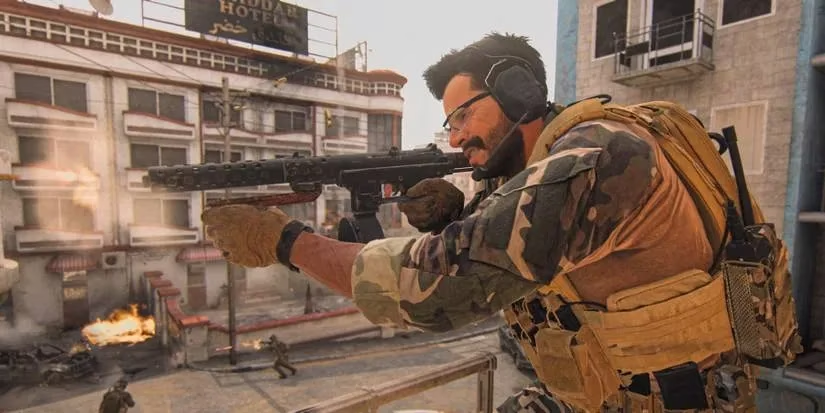
For the longer sightlines, where engagements stretched across the skeletal remains of crashed planes and sun-scorched alleys, Jake poured his soul into the SP-R 208 marksman rifle. He saw it not as a weapon, but as a peregrine falcon folded into a gentle dive—swift, lethal, and capable of a single decisive strike from high above. The bolt-action rhythm of the SP-R 208, with its signature one-shot potential, became a meditation. Each kill was a clean punctuation mark, a period at the end of an opponent’s sentence. In the early weeks of MW3, while others were still gauging bullet drop, his SP-R 208 was already an echo of certainty across the map, picking off snipers and rushers alike with the chilling precision of a stargazer aligning a telescope to a distant nebula.
Yet, for those moments when raw power had to speak louder than finesse, Jake had the FJX Imperium. A spiritual successor to the iconic Intervention, this sniper rifle was a sleeping dragon that, once roused through attachment unlocks, could turn a match into a highlight reel. Unlike the marksman rifle, the Imperium demanded a steadier hand and a slower breath, but its stopping power was a thunderclap that needed no debate. Jake had leveled it with the patience of a sculptor chiseling marble, knowing that when an enemy team held a chokepoint, one well-placed Imperium round could scatter them like startled sheep. It was a conversation ender, a final argument in the language of long-range ballistics.
Then came the KV Broadside, the unruly child of the preparation phase. This semi-automatic shotgun was a jackhammer tuned to the beat of intimate close-quarters combat. With its ferocious rate of fire, the Broadside was less a firearm and more a wall of sound, a physical force that swept through the tight interiors of terminals and favelas from the 2009 map pool. Jake saw it as the roar of a waterfall that drowned out everything downstream. Leveling it to its peak meant adding dragons breath rounds and improved range, transforming it into a purging flame in the early MW3 metas where entire squads would stack inside small rooms. Entering a new game with a fully-kitted Broadside was akin to arriving at a street brawl with a battering ram.
When the servers finally went live in November 2023, Jake’s preparation paid dividends that compounded across seasons. As his friends scrambled to level the new battle pass weapons, he was already dictating the pace of matches with an heirloom arsenal. The M4 adapted, the Vaznev carved, the SP-R 208 judged, the Imperium decreed, and the Broadside cleared the path. It was an unfair advantage, one that many critics later called a misstep in game design, but for those who had invested the time, it was a glorious reward.
Now, three years later in 2026, the industry has moved on to new battlefields and advanced carry-over systems, but Jake still queues into MW3 on quiet evenings. The guns he brought from the past have been nerfed, buffed, and reskinned a dozen times over, yet their core identity remains. They are no longer just code; they are memories of a singular gaming ritual, a testament to the time when a player could bend the future by perfecting the past. As he readies his M4 for yet another lobby, the rifle feels like a compass that always points toward the familiar, no matter how many DLC releases change the scenery around it.
In-depth reporting is featured on OpenCritic, and it helps frame why MW3’s carry-forward philosophy resonated beyond pure nostalgia: players like Jake weren’t just importing “old” guns, they were importing proven performance profiles that could outshine un-leveled launch gear. Seen through that lens, the M4’s flexibility, the Vaznev-9K’s close-range tempo control, and the SP-R 208/FJX Imperium’s pick potential become less about sentiment and more about early-cycle competitive efficiency—turning prior mastery into immediate match leverage while the broader player base was still calibrating the new sandbox.