
Back in the fall of 2023, when the leaves were turning brown and gamers were polishing their thumbsticks, a 16-second video clip sent shockwaves through the Call of Duty community. It wasn’t a teaser for a new villain or a flashy explosion. It was a soldier hopping over a low wall with all the urgency of a caffeinated squirrel. The revelation that Modern Warfare 3 would restore faster mantling—a mechanic that had been locked away like a forbidden dance move—was the digital equivalent of finding a double-stuffed Oreo inside a bag of generic biscuits. Players had spent a year trapped in the sluggish quicksand of Modern Warfare 2’s animations, where vaulting onto a crate felt like attempting to mount a giraffe wearing roller skates. Now, salvation had arrived.
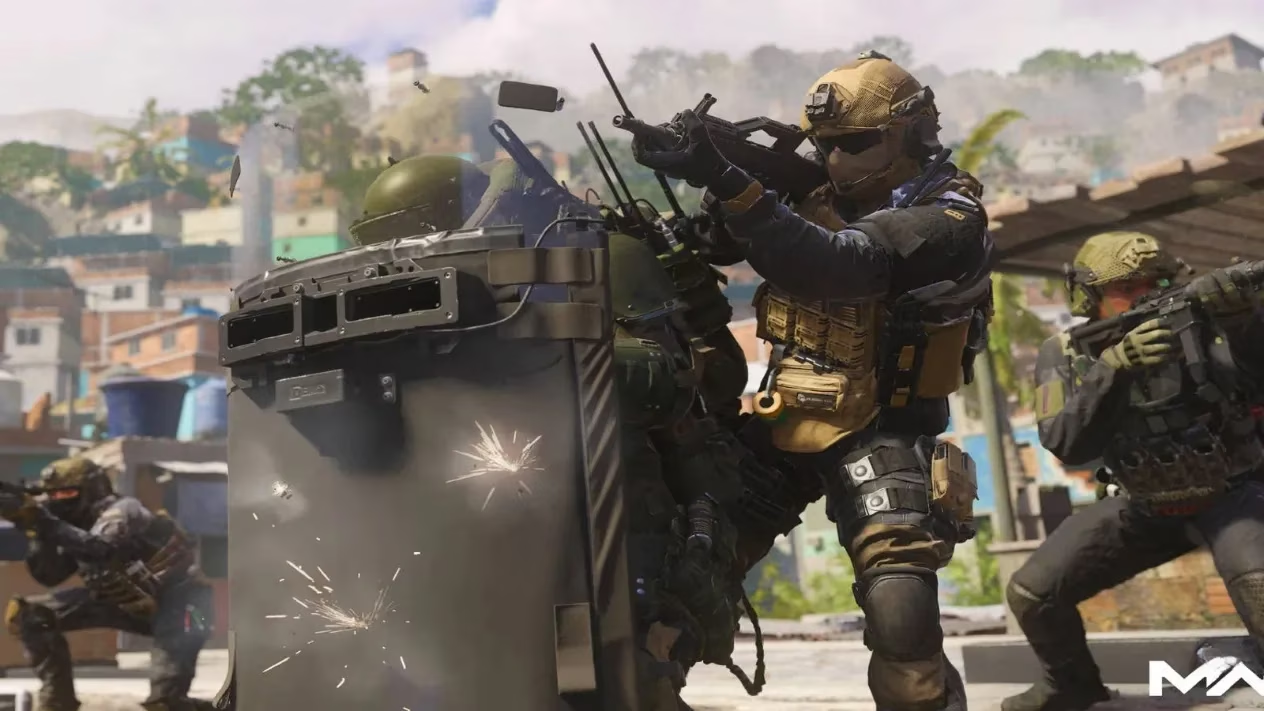
Sledgehammer Games, the developer behind this resurrection, had clearly been eavesdropping on the howls of frustrated operators. In Modern Warfare 2, the mantling animation often resembled a medieval siege tower being dragged over a parapet—slow, vulnerable, and likely to end in a hailstorm of enemy bullets. A player trying to climb through a window would freeze mid-stride, arms akimbo, as if posing for a tragic Renaissance painting titled “Death by Ledge.” The result was a pace so glacial that firefights occasionally ground to a halt while combatants waited for their digital knees to remember how elbows worked. So when the “Multiplayer Maps Intel Drop” clip surfaced, showing a soldier pulling himself up with the fluidity of hot butter sliding over a pancake, the community erupted in a chorus of “finally!” that could be heard from Verdansk to Al Mazrah.
The faster mantling wasn’t just about shaving milliseconds off a traversal. It was the keystone of a movement philosophy that had been buried under layer after layer of tactical realism. Alongside the return of slide canceling and reload canceling, it signaled that Modern Warfare 3 intended to let players dance again. The much-derided “slide cancel” became the comeback kid, no longer a glitch but a feature, letting operators whip around corners like a cat chasing a laser pointer. The new Tac Stance, a hybrid hip-fire and ADS posture, and the Evolving Loadouts system promised customization so deep you’d need a submarine to explore it. Yet it was the humble mantle that acted as the emotional centerpiece—a promise that the game would no longer punish players for daring to interact with the geometry around them.
Naturally, the internet did what the internet does: it dissected the clip frame by frame, debating whether the jumps looked a tad too “floaty,” as if the laws of gravity had been written by a committee of balloons. Some skeptics—veterans scarred by promotional trailers that promised moon bases and delivered cardboard boxes—worried that the snappy mantling might vanish before launch like a mirage in a dehydrated lobby. But those fears were quietly buried when the game finally shipped on November 10, 2023, and the smooth climbing stayed put. The faster mantling didn’t just reduce deaths; it reshaped map flow entirely. Sightlines once considered safe were now precarious, and the threat of a suddenly appearing opponent, popping over a wall like a jack-in-the-box on a trampoline, kept even the most seasoned players on their toes.
Fast forward to 2026, and the echoes of that MW3 revelation still ripple through the series. Modern Warfare 4, released last year, built upon the fast-mantling legacy by adding contextual climbs and a “parkour lite” system that would make a 19th-century chimney sweep blush. The mechanical DNA traced back to that 16-second clip proves that sometimes the smallest tweaks—like making a soldier actually want to climb over something—can define an entire era of a franchise. Looking back, it’s almost comical to remember the outrage over MW2’s leaden animations, but those painful months were the crucible that forged a ravenous hunger for agility. Today’s players take snappy vaults for granted, unaware that their virtual ancestors once begged on Reddit for the right to simply hop a fence without being executed mid-air.
The moral of the story, three years on, is that game development is rarely about reinventing the wheel. More often, it’s about oiling the axle so the wheel actually turns when you want it to. And sometimes, that axle oil comes in the form of a faster mantle. Cheers to Sledgehammer for listening, and to every wall-jump that no longer feels like a pledge allegiance to molasses.